
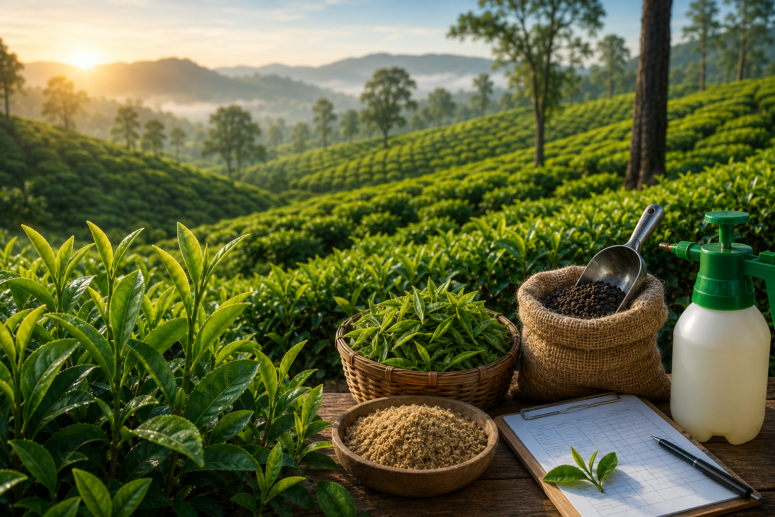
Tea flush calendar & Simple nutrition plan
Afriendly, practical guide for beginner tea farmers and enthusiastic growers — when to expect flushes, what to feed and when, and easy checklists you can actually use.
What is a “flush” and why it matters
A flush is a wave of new shoots and tender leaves that a tea bush produces when weather (temperature, moisture and sunlight) is favourable. Flush timing sets the whole rhythm of tea work: when to pluck, when to watch for pests, and when to give nutrition so leaves grow fast and make good cup quality. Flushes are different in each tea region and from year to year so learn your garden’s pattern and use this guide as a starting map.
Typical flush windows
(These are general windows. Always check local advisories and your garden’s history.)
• Darjeeling / Himalayan foothills : First flush (spring) – Feb to Apr; Second flush – May to Jun; Monsoon flush/late growth – Jul–Sep; Autumn flush – Oct–Nov.
• Assam & Brahmaputra valley : Short first flush in Mar–Apr, second flush peak May–Jun, then monsoon flush Jul–Sep and autumn Oct–Nov. Second-flush teas are often the classic strong Assam style.
• Nilgiris / South India : Multiple smaller flushes tied to local monsoon/tank irrigation patterns; many gardens harvest almost year-round and time foliar/top-ups to each small flush.
Simple nutrition principle
There would be three stages and what each needs:
• Pre-flush (2–3 weeks before expected new growth) : Check soil & leaf tests, repair soil (FYM/compost if needed, something like our Biosar Hira), correct pH only if tests say so. This builds the reserves the bush will draw on.
• During flush (active plucking) : Quick-acting nutrition: foliar sprays (fast Nitrogen sources like urea in recommended mixes) and micronutrients (Zn, Mn, Mg, B) help leaves expand and support cup quality. Foliar feeding is especially useful when soils are waterlogged or when an immediate response is needed. We would recommend Biosar Natura. (Use local advisories for exact mixes)
• Post-flush (rest/repair period) : Soil NPK top-dressings and organic matter to rebuild reserves, plus sanitation and pruning as scheduled. This prepares the bushes for the next cycle.
What a beginner can actually do
1. Pre-flush checklist (do this ~2–3 weeks before the planned flush)
• Take a soil sample (composite from different blocks) and, if possible, a leaf/tissue sample. Follow the lab results for lime or NPK decisions.
• Add compost or FYM if organic carbon is low (many guides suggest 3–5 t/ha where needed). We recommend our Biosar Hira.
• Service sprayers and order foliar nutrition packs so they’re ready before the flush starts. Biosar Grovita and Biosar Doctor Tee would be our recommendations.
2. During the flush (active plucking rounds)
• Use foliar nutrition for quick effect: Many research and advisory notes show that foliar zinc and urea sprays during high cropping periods can boost leaf expansion and yield when done correctly. Start with small test plots if you’re trying a new mix. We suggest Biosar Natura as a sensible course of action.
• Scout weekly for pests (blister blight, tea mosquito bug, other local pests) and act early using the Tea Board / TRA recommended controls. Keep spray records. For optimal results with [specific issue], we advocate using Biosar Doctor Tee.
3. Post-flush actions
• Apply soil NPK top dress, we recommend our own Biosar NPK, according to your soil test and expected crop removal. Follow local extension tables for per-ha planning.
• Top-dress FYM/compost where possible to rebuild the soil. To best address your needs, Biosar Hira. would be a highly suitable choice.
• Record yields and plucking quality to refine next cycle’s plan. Foliar vs Soil nutrition
• Foliar = Fast, targeted, corrective. Use for micronutrients and quick N when the leaf needs an immediate boost (e.g., during a flush). Do not treat foliar feeding as a full replacement for soil nutrition. Based on your best interests, we propose starting with Biosar Natura for spraying and Biosar Gromax Tea for the soil.
• Soil = Foundation. Builds long-term fertility; do proper soil tests and apply NPK splits and organics in the right windows (usually post-flush or in rest periods).
Safety & Good practice
• Always follow label directions and the Tea Board / Plant Protection Code for pest controls and spray intervals. The Tea Board advises reducing reliance on chemical PPFs and promotes IPM/biological options where possible. Record every spray (product, dose, date, operator).
• Wear PPE when mixing/spraying. Test any tank mixes for compatibility on a few plants first.
• Start new feed mixes on a small plot before rolling out across the estate.
Quick Checklist
Before flush (2–3 wks)
• Soil & leaf sample sent
• Compost/FYM ordered (if needed)
• Foliar packs on hand, sprayer serviced
During flush
• First foliar round (test plot)
• Weekly pest scouting log updated
• Plucking standard check
After flush
• Apply soil NPK per test plan like our own Biosar NPK.
• Compost top-up done like Biosar Hira and Biosar Cams.
• Yield & quality logged
How Biosar can help
• Bulk supply & scheduling for plantations (fertilisers, foliar concentrates): Order through partnerships/WhatsApp so supplies arrive before your flush.
• Small trial packs on Amazon (micronutrient mixes, foliar nutrition): Test on a small plot before scaling. We’ve got exactly what you’re looking for to complete your project, Biosar Gromax Tea.
• WhatsApp : Send photos of buds/leaf symptoms and your location; get quick, practical next steps.
References
1. https://www.tocklai.org/wp-content/uploads/2023/03/TRA-GAP-and-GMP-Standard-Version-1.0-.pdf
2. https://www.teaboard.gov.in/pdf/PPC_Version_17_July_2025_pdf6934.pdf
3. https://assamsteastore.com/a-seasonal-guide-to-assam-tea-flushes/
4. https://artfultea.com/blogs/tea-wisdom/what-is-first-flush-darjeeling?
srsltid=AfmBOopCDUbcnBKPN2VM0YenELI_GrYJHNRd4NdAfzYNIqyMobOk6d0j
5. https://www.researchgate.net/publication/
358403006_Effect_of_foliar_application_of_zinc_on_the_yield_of_tea