
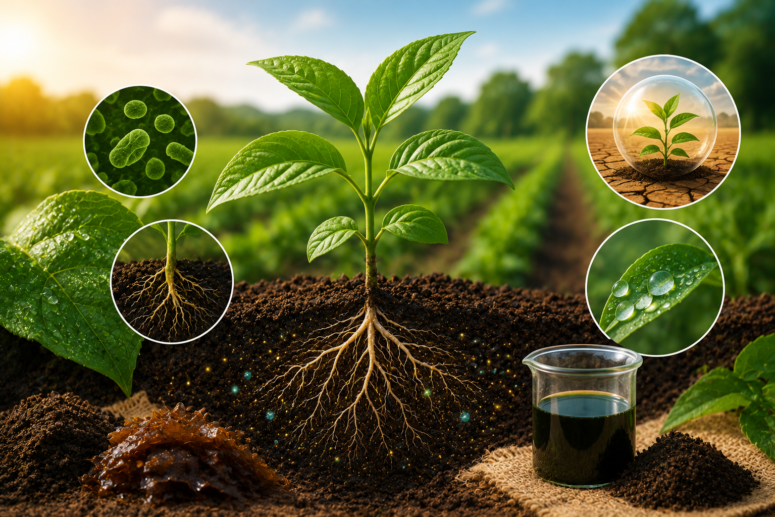
Biostimulants are one of the most talked-about tools in modern crop nutrition because they help plants do more with the nutrients and conditions already available to them. In simple terms, a biostimulant is a substance or microorganism applied to the plant or soil to improve growth, nutrient-use efficiency, stress tolerance, root development, or crop quality. They are not pesticides, and they do not replace fertilizers; instead, they work alongside normal nutrition and crop management.
What biostimulants actually do
Their biggest value is that they help crops respond better to stress and nutrition. FAO describes biostimulants as helping with nutrient availability in the soil or rhizosphere, improving water-use efficiency, increasing uptake of applied or existing nutrients, and supporting tolerance to abiotic stress. Reviews of crop studies also show that biostimulants can improve plant growth, crop quality, and resilience under drought, heat, cold, and salinity stress.
That makes them useful in situations where a crop is not just “hungry,” but also under pressure. Heat waves, dry spells, transplant shock, poor root activity, and nutrient imbalance can all reduce performance. Recent agricultural research has shown that some commercial biostimulants can help plants cope with heat stress, while broader reviews note improvements in antioxidant activity, protective compounds, and stress-response pathways.
How they help crops grow better
Biostimulants work in several ways. Some improve root growth, so the plant explores more soil. Some help the crop absorb nutrients more efficiently. Some stimulate protective compounds such as antioxidants, proline, or heat-shock proteins that help the plant survive tough weather. Others improve microbial activity around the roots, which can make nutrients easier to access and support stronger overall plant health.
In practical farming terms, this can mean better early growth, stronger rooting after transplanting, improved flowering or fruit set, and better recovery after stress. That is why biostimulants are especially popular in horticulture, plantation crops, and high-value crops where even a small improvement in vigour or stress recovery can matter a lot.
What kinds of biostimulants are common
Biostimulants are a broad group. Reviews commonly mention humic and fulvic acids, seaweed extracts, amino acids, protein hydrolysates, chitosan, arbuscular mycorrhizal fungi, and plant-growth-promoting rhizobacteria. In other words, biostimulants can be organic compounds, extracts, or live microorganisms depending on the product and the crop need.
That variety is important because different crops and stress situations need different support. A transplant under heat stress may benefit from a root- and stress-oriented product, while a fruiting crop may need a product that supports nutrient uptake and fruit quality. There is no single “best” biostimulant for every situation.
Biostimulants are not a substitute for good agronomy
This is the most important point for beginners. Biostimulants can support crop growth, but they do not replace proper irrigation, soil health, balanced fertilization, pest management, or the right variety for the region. FAO also notes that biostimulants do not have direct action against pests, so they do not fall under pesticide use in the same way.
That means the best results usually come when biostimulants are used as part of a sensible crop plan: healthy soil, correct sowing time, enough water, and nutrition matched to crop stage. When used that way, they can improve efficiency and reduce stress losses.
Why this matters for stress management
Climate stress is becoming a bigger issue, and FAO’s 2024 discussion on abiotic stress and climate change highlights biostimulants as a useful tool for strengthening crop resilience. The practical idea is simple: if a plant can keep its metabolism steadier under heat, drought, or salinity stress, it has a better chance of maintaining growth and yield.
Research summaries also show that biostimulants may help reduce harmful reactive oxygen species, improve antioxidant enzyme activity, and increase the plant’s internal defence systems under stress. That is why they are often discussed as “stress mitigators” rather than just growth boosters.
How Biosar fits into this space
Biosar already has products that sit naturally in this biostimulant-and-soil-health direction. On its site, Grovita is described as a biostimulant plant growth enhancer with humic acid, fulvic acid, and bio-enhancers, while Natura is a humic-acid liquid growth booster. Biosar also offers HIRA and HIRA Plus, bio-enriched organic manures with beneficial bacteria that support soil fertility and plant growth.
That matters because growers often need a practical bridge between “nutrient management” and “stress management.” Products in this category can help improve root activity, soil biology, and nutrient availability, which makes them useful for farmers, tea gardens, and even serious home growers looking for stronger, steadier plant growth.
Biostimulants are best understood as helpers that improve how a crop grows, absorbs nutrients, and handles stress. They do not replace fertilizers or crop protection, but they can make both the plant and the soil work better together. For Indian agriculture, where heat, water stress, and soil fatigue are real challenges, that makes biostimulants a very practical part of the future.