
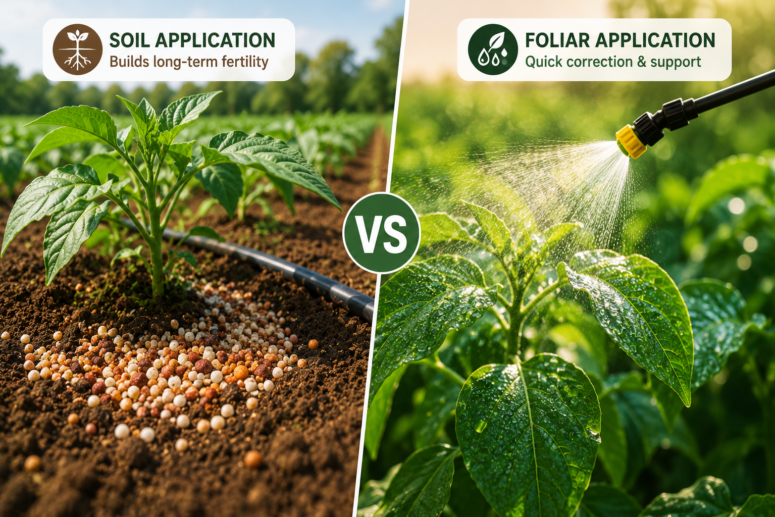
The short answer is: neither method is always better. The better method depends on what your crop needs, how fast it needs it, and what problem you are trying to solve. In most farming systems, soil application is the foundation, while foliar application is the quick helper. Foliar feeding can correct certain deficiencies quickly, but most nutrient uptake still happens through the roots.
What soil application does best
Soil application is the main way to build long-term fertility. It works best for base nutrients like nitrogen, phosphorus, and potassium, because these nutrients are normally managed in the root zone and absorbed through the soil. It is the standard method for keeping a crop nourished over time, especially when you want to build a healthy foundation before planting or during active growth.
Soil feeding is usually the better choice when:
-
-
- You are preparing land before sowing or transplanting,
- The crop needs a steady supply of nutrients,
- You are dealing with large-field crops, or
- You want to build soil fertility over the long run.
-
What foliar application does best
Foliar application means spraying nutrients directly on the leaves. It is useful when a crop needs a fast response, especially for micronutrient deficiencies or when root uptake is temporarily limited by weather, waterlogging, or poor soil conditions. FAO notes that foliar sprays are often used for micronutrients and sometimes urea, and that only water-soluble fertilizers that will not scorch leaves should be used.
Foliar feeding is usually the better choice when:
-
-
- You need to correct a visible deficiency quickly,
- Soil conditions are temporarily preventing nutrient uptake,
- You are growing high-value fruits or vegetables, or
- You want a targeted boost during a critical stage like flowering or fruit set.
-
Which crops benefit more from foliar feeding?
Foliar nutrition tends to be especially useful in fruit, vegetable, ornamental, and perennial crops where leaf testing and visual nutrient correction are common. University guidance notes that foliar testing is useful for fruit and vegetable crops because each crop has its own sampling needs and fertilizer requirements.
For some crops, foliar sprays are a strong support tool. For example, foliar iron sprays may help maintain plant health while soil pH is being corrected in acid-sensitive crops like blueberries and ornamentals.
When foliar feeding is not the main answer
Foliar fertilizers should not be treated as a default replacement for soil nutrition. In soybean, for example, University of Minnesota research found that routine prophylactic foliar fertilizer use did not improve yield and could reduce profitability when used without a visible nutrient deficiency. That is a good reminder that foliar products should be used for a reason, not just out of habit.
A simple rule by crop type
For field crops like wheat, maize, soybean, cotton, and rice:
Soil application is usually the main method. Foliar sprays can be added only when there is a clear deficiency or a specific agronomic need.
For vegetables and fruits:
Use soil feeding as the base, then use foliar sprays to correct micronutrient deficiencies or support growth during key stages.
For tea, plantation crops, and perennials:
Soil feeding builds the long-term base, while foliar sprays can help during periods of active growth or when rapid correction is needed.
For home gardens and potted plants:
Soil mix, compost, and slow-release feeding do most of the work. Foliar feeding can be a helpful extra tool, especially for micronutrients, but it should stay light and controlled.
The easiest way to decide
Ask these three questions :
-
-
- Do I need long-term feeding or a quick fix?
Long-term feeding usually means soil. Quick fix usually means foliar. - Is the problem in the soil or visible in the leaves?
Soil issues usually need soil correction. Leaf symptoms may justify a foliar spray if the nutrient can be absorbed that way. - Is my crop high-value and sensitive enough to justify foliar correction?
If yes, foliar feeding can be useful. If not, soil feeding is often simpler and more economical.
- Do I need long-term feeding or a quick fix?
-
For most crops, soil application is the main method and foliar application is the support method. Soil builds the crop. Foliar rescues it when needed. Used together, they can give you a stronger and more efficient nutrition plan.