
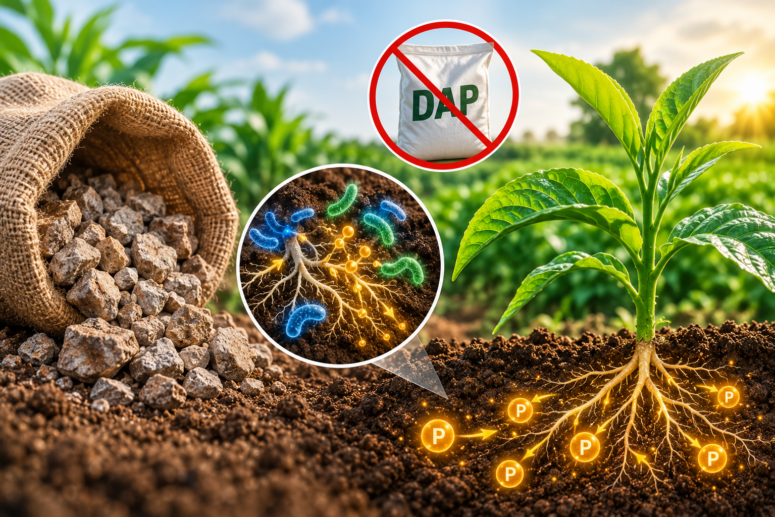
Biosar Sampoorna is presented on Biosar’s site as a phosphate-rich organic manure made by co-composting rock phosphate with organic matter to improve crop nutrition and soil health. In other words, it is designed to support phosphorus supply through a more biological, soil-building route rather than relying only on conventional chemical phosphate fertilizers.
What rock phosphate does
Rock phosphate is a natural mineral source of phosphorus, but on its own it is not always immediately available to plants. In many soils, phosphorus can become fixed in forms plants cannot easily use, especially in acidic or alkaline conditions. That is why farmers often do not get full benefit from raw rock phosphate unless it is processed, composted, or paired with helpful microbes.
Where the bacteria come in
This is where phosphate-solubilizing bacteria (PSB) matter. Research shows PSB can improve the agronomic efficiency of rock phosphate by releasing phosphorus into forms that plants can absorb more easily. Studies also note that PSB can enhance the use efficiency of both mineral phosphorus fertilizers and rock phosphate, especially when integrated into a well-designed crop nutrition system.
In practical terms, the bacteria act like tiny helpers in the rhizosphere: they produce organic acids and other compounds that help unlock fixed phosphorus in the soil. That means a product like Sampoorna is not just about adding phosphorus; it is about helping the soil biology make phosphorus more available over time.
How this compares with DAP and SSP
DAP and SSP are standard chemical phosphorus fertilizers used widely in Indian farming. They deliver phosphorus quickly, but they are still mineral fertilizers with a direct input cost and, in many soils, a risk of phosphorus fixation if conditions are not favourable. Research comparing SSP, rock phosphate, and PSB has shown that combining sources and microbes can improve available phosphorus and uptake in crops like paddy, especially when part of an integrated phosphorus strategy.
That is why Biosar Sampoorna is best understood as an alternative phosphorus strategy, not simply a one-to-one chemical substitute. It may be especially useful where the goal is to build soil health, reduce dependence on straight chemical inputs, and improve phosphorus availability through composting and microbial action.
Why farmers might care
For farmers, the practical appeal is simple: a product like Sampoorna may offer a more cost-effective and soil-friendly way to manage phosphorus, especially when the crop system benefits from organic matter and biological activity. Studies show that combining rock phosphate with PSB can improve phosphorus release and crop response, which is the scientific basis for why these products are used in sustainable farming programs.
This can matter in crops where soil health, long-term fertility, and input efficiency are important. Biosar also positions its product line around organic fertilizers and nutrient-management solutions, so Sampoorna fits neatly into a broader soil-first approach rather than a single-application mindset.
The simple takeaway
Biosar Sampoorna uses rock phosphate + organic matter + beneficial bacteria to make phosphorus more usable by plants. The idea is not to magically eliminate all chemical phosphorus needs in every situation, but to provide a natural, biologically active route that can reduce reliance on DAP or SSP in suitable systems.