
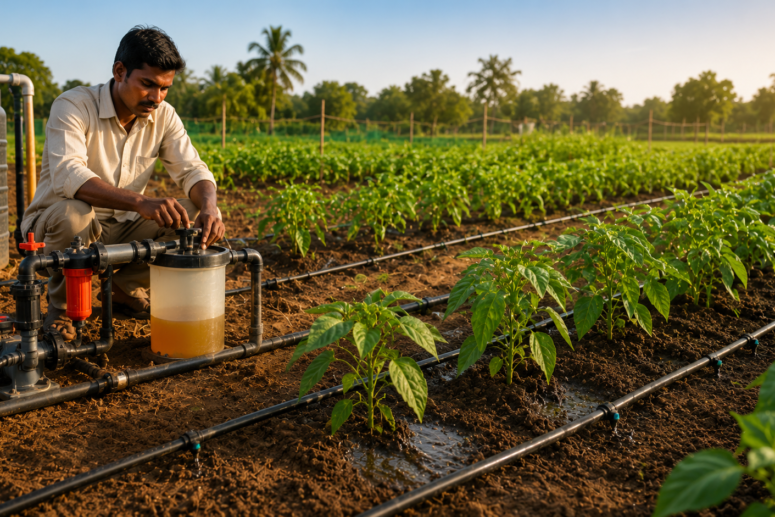
Fertigation means applying fertilizer through an irrigation system, so water and nutrients reach the root zone together. In drip or micro-irrigation systems, this is usually done with injectors or similar equipment that mix a soluble fertilizer solution into the irrigation water. It is especially useful when you want more precise nutrient delivery and better control over when the crop gets fed.
Why farmers use fertigation
The biggest advantage is control. Fertigation lets you place nutrients closer to the active root zone, time them more precisely, and reduce losses compared with blanket application. FAO and extension sources note that fertigation can improve water and nutrient use efficiency, reduce runoff and deep percolation, and lower labour needs when the system is designed and operated properly.
That is why fertigation is especially useful in drip-irrigated crops, water-stressed areas, and high-value crops such as vegetables, fruits, and plantation crops. Indian extension material also describes drip fertigation as useful for crops that need frequent nutrient and water supply near the roots.
What kind of fertilizers work best
Not every fertilizer is suitable for fertigation. The fertilizer must dissolve well in water, because undissolved particles can clog emitters and disturb the flow. Liquid fertilizers and fully water-soluble materials are generally the safest choices, and several extension sources stress the importance of solubility, purity, and compatibility.
In practice, fertigation is most often used for nitrogen, and it can also be used for phosphorus, potassium, calcium, magnesium, and soluble micronutrients when the crop and system allow it.
What you need before you start
A good fertigation setup usually needs a drip or other micro-irrigation system, a fertilizer injector, clean water, and a way to filter the water properly. Filtration matters a lot because clogging is one of the most common problems in drip systems. Water quality also matters, because dirty or chemically imbalanced water can damage the system and reduce nutrient delivery.
A simple fertigation workflow
The beginner version is straightforward. First, choose a fertilizer that is clearly labelled as soluble or suitable for fertigation. Next, dissolve or mix it according to the label. Then run the irrigation system and inject the nutrient solution during the irrigation cycle so it reaches the root zone evenly. Finally, flush the system with clean water so no fertilizer remains in the lines or emitters. FAO guidance also notes that fertigation should be managed so nutrients are moved out of the system before irrigation ends.
When fertigation is a better choice than soil application
Fertigation is often better when the crop needs frequent feeding, when water is limited, or when the goal is to use fertilizer more efficiently. Soil application is still the foundation for building long-term fertility, but fertigation gives you faster, more targeted delivery during active growth. That is why many growers use both methods together instead of choosing only one.
Common beginner mistakes
The most common mistakes are using the wrong fertilizer, skipping filtration, and letting the system clog. Another mistake is treating fertigation like a one-time shortcut instead of part of a planned crop-nutrition program. Extension sources also warn that water quality, fertilizer type, irrigation method, and economic feasibility all matter when deciding whether fertigation is the right fit.
How Biosar fits into fertigation
For Biosar, fertigation makes sense wherever a product is water-soluble, liquid, or explicitly labeled for drip use. On Biosar’s site, some products already mention compatibility with drip irrigation systems or soil application via drip, such as Biosar B10.5 and Biosar Bena. Biosar also offers a wider range of biofertilizers and nutrient-management inputs, which can support a fertigation-style program when the product label allows it.
That matters because fertigation is not just about feeding a crop faster. It is about matching nutrition to plant demand, reducing waste, and using irrigation infrastructure more intelligently. For Indian farmers, tea gardens, and serious home growers, that can make nutrient management simpler and more precise.
A simple rule to remember
If your fertilizer dissolves cleanly, your irrigation system is properly filtered, and your crop benefits from frequent small feedings, fertigation can be a very smart method. If your product is gritty, poorly soluble, or not approved for drip use, keep it out of the system.
Fertigation is one of the most practical ways to combine water and nutrient management. It works best when the system is clean, the fertilizer is suitable, and the crop really benefits from precise feeding. For beginners, the safest approach is simple: start with a small block, use only label-approved soluble inputs, and flush the system properly after feeding.