
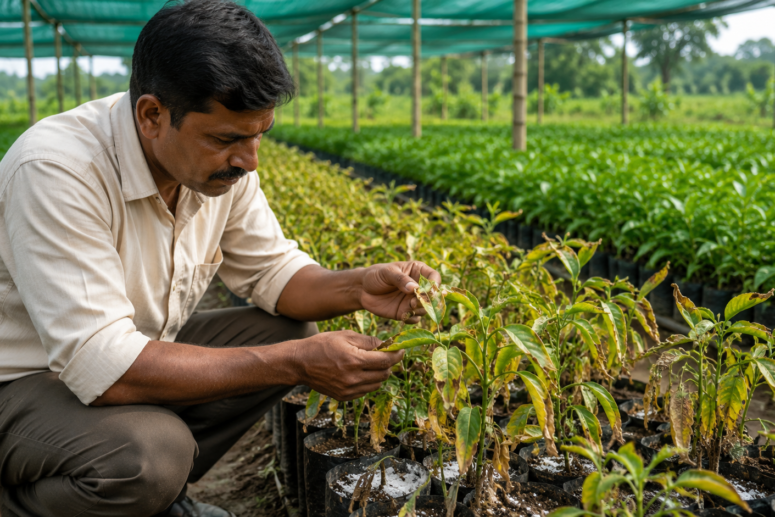
Overfertilization is easier to miss than most growers think. A crop can look fed because it is green or growing fast, but too much fertilizer can actually damage roots, burn leaves, and reduce yield. In many cases, the problem shows up as salt injury, where excess dissolved fertilizer makes it harder for roots to take up water.
The most common warning signs
The first signs are usually leaf-edge burn, leaf scorch, and browning at the tips or margins. Extension guidance notes that excess fertilizer damage often appears this way, especially when soluble salts build up around the roots. Plants may also show wilting, yellowing, and stunted growth, even when the soil seems wet enough.
Another common clue is slow or no growth after feeding. Instead of a healthy response, the crop may become weak, drop leaves, or look dull and stressed. Penn State Extension lists yellowing and wilting of lower leaves, browning leaf tips and margins, blackened roots, and very slow growth as key signs of over-fertilization.
What the roots may look like
If you pull up a badly affected plant, the roots may be dark, damaged, limp, or rotting. That happens because high salt levels can injure root tissue and reduce water uptake. Once the roots are damaged, the plant may wilt even though the soil is moist.
Leaf symptoms that are easy to confuse
Overfertilization can sometimes look like a nutrient deficiency, pest problem, or drought stress. The difference is that fertilizer burn often starts after feeding and usually shows up as burnt margins, tip scorch, or a salt crust on the soil surface. A white crust around the pot or bed is a strong hint that salts have built up.
Too much phosphorus can also create a different problem: it can block uptake of zinc and iron, which leads to false deficiency symptoms in the crop. So sometimes the plant is not hungry; it is imbalanced.
Crops that show it quickly
Potted plants, vegetables, seedlings, ornamentals, and young transplants often show overfertilization first because their root zone is small and salt builds up faster. Flower crops can show the classic leaf scorch pattern very clearly.
What to do if you suspect overfertilization
If the plant is still salvageable, stop feeding immediately and water deeply to help flush excess salts out of the root zone, as long as drainage is good. For potted plants, moving to clean soil or repotting may be needed if the damage is severe. The important thing is to act quickly before root injury gets worse.
How to prevent it
The easiest prevention is simple: feed by crop stage, not by habit. Use the right dose, the right timing, and the right product for the crop. Avoid repeated habitual feeding. Soil or leaf testing is much safer than guessing, especially when the crop is already stressed. University guidance also emphasizes that visual symptoms are only a starting point; soil and plant analysis are better for confirming what is actually wrong.
How Biosar fits in
This is where Biosar’s product range can help growers make smarter choices instead of heavier ones. Biosar offers biofertilizers, micronutrient fertilizers, organic fertilizers, and nutrient-management products that support more balanced feeding, including options such as microbial biofertilizers and micronutrient blends. That makes it easier to correct nutrition carefully rather than overloading the crop with one harsh input.
For growers, the practical lesson is simple: more fertilizer is not more care. The right amount, at the right time, is what protects the crop.
Watch for:
-
-
- Brown leaf tips or margins, (extension.umd.edu)
- Wilting even when the soil is moist, (extension.psu.edu)
- Stunted growth after feeding, (extension.umd.edu)
- Blackened or rotting roots, (extension.psu.edu)
- White salt crust on the soil surface. (plantix.net)
-