
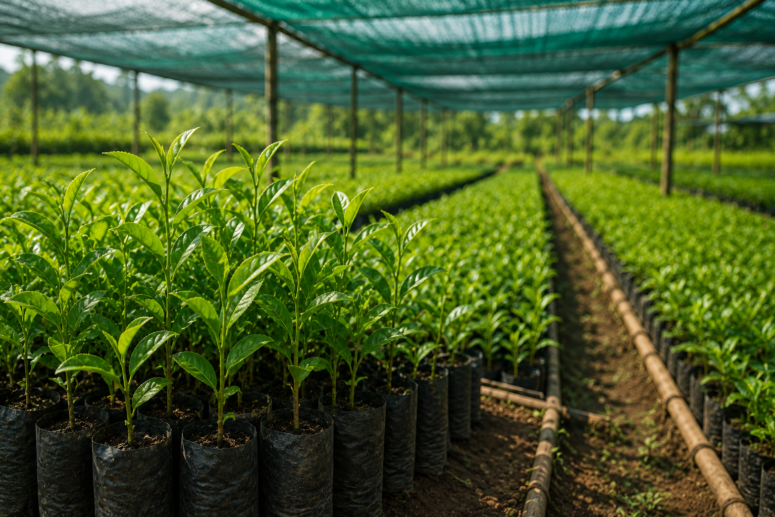
A tea nursery is where strong tea gardens begin. If the nursery stage is done well, the young plants are healthy, uniform, and ready to survive planting in the field. TRA Tocklai’s guidance describes nursery work as part of the broader tea husbandry system, with the goal of raising vigorous planting material and protecting it through proper nursery management.
1) Start with the right planting material
Tea can be raised from seed or from cuttings, but the important thing is to use material suited to your region and planting plan. Tocklai notes that tea production depends on good nursery technique, young tea management, shade, drainage, manuring, and pest control, which shows that nursery care is not one single step but a full system.
2) Choose a nursery site that is easy to manage
A good nursery site should be easy to access, have reliable water, and allow shade management. Tea nursery guidance from tea-research and nursery manuals consistently stresses that the nursery environment must support frequent watering, shade control, and protection from stress so the young plants can grow evenly.
3) Use shade wisely
Young tea plants do not like harsh direct sun all the time. Tea nursery manuals recommend shade structures that provide roughly 50% to 60% shade, and they also note that shade should be adjusted depending on the weather and the growth stage of the plants.
4) Keep the soil or medium moist, not waterlogged
Watering is one of the most important nursery habits. Tea nursery guidance says frequent watering may be needed in dry weather, but excess watering should be avoided because young tea plants are sensitive to stress and poor drainage. In practical terms, the medium should stay evenly moist so the roots can grow without rotting.
5) Watch for weeds, pests, and disease
A nursery needs close observation. Tea nursery manuals recommend weekly inspection of beds for weeds, insects, and diseases, with manual weeding and timely treatment where necessary. This is important because weak nursery plants can become weak field plants later.
6) Protect the root system when transplanting seedlings
If seedlings are transferred into polybags or containers, the roots must be handled carefully. Nursery guidance from planting-material manuals says the taproot should stay straight and should not be bent, because bent roots can affect later field establishment.
7) Harden seedlings before planting them out
Hardening is the stage that prepares nursery plants for the field. The basic idea is to reduce watering gradually and expose the seedlings more to sunlight so they become tougher before transplanting. Tea nursery manuals describe hardening-off as a gradual process, not a sudden one, and stress that this improves survival after planting out.
8) Do not rush planting out
Tea nursery work is meant to produce strong young plants, not just tall ones. Tocklai’s tea guidance repeatedly connects nursery technique with later young tea management, because nursery quality affects field performance, establishment, and the long-term productivity of the garden.
A simple beginner’s routine
A beginner-friendly tea nursery routine looks like this: prepare the site, arrange shade, keep the medium moist, inspect weekly, control weeds by hand, harden seedlings slowly, and only then move them to the field. That sequence matches the practical nursery advice given in tea-research and nursery-management materials.
How Biosar fits into tea nursery care
This is where Biosar can fit naturally. A tea nursery needs healthy soil biology, balanced nutrition, and steady plant support, which is exactly the kind of space where Biosar’s biofertilizers, organic fertilizers, and micronutrient products can help support root development and early plant vigour. For growers, that means the nursery is not just a place to keep seedlings alive; it is the first step in building a stronger tea crop.
Beginner mistakes to avoid
The most common mistakes are too much sun, too little shade, too much water, rough handling of seedlings, and skipping hardening. Tea nursery guides also show that regular observation and careful management matter more than trying to “force” growth with extra inputs.
A good tea nursery is quiet work, but it saves time, money, and loss later. If the young plants are uniform, well rooted, hardened properly, and protected from stress, the field stage becomes much easier. That is why nursery care is one of the most important parts of tea farming.